Category: Essays

Stories and anecdotes from past and present

  • Masana Kollai – Raid of the cremation grounds

    Masana Kollai – Raid of the cremation grounds

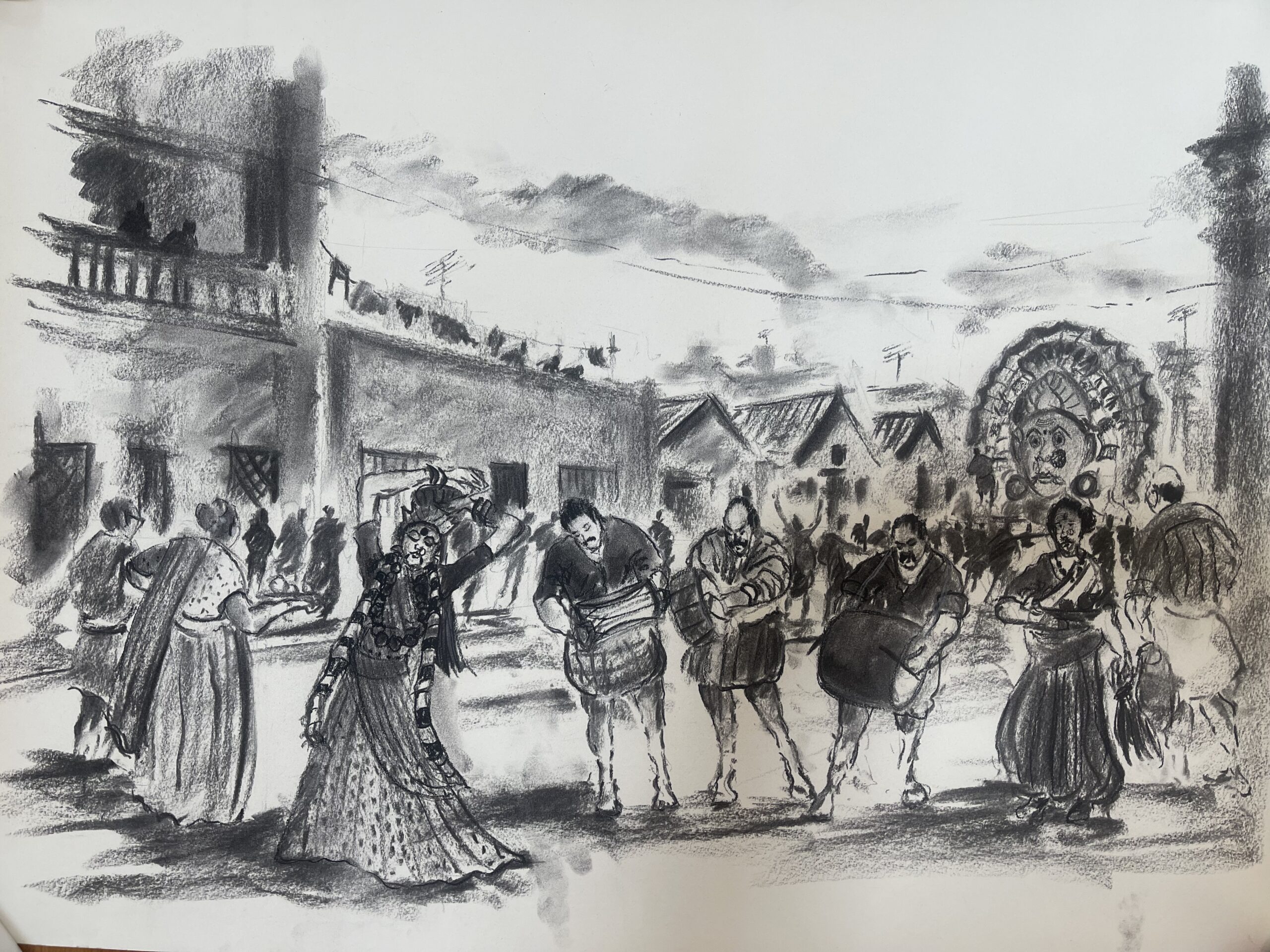
    Although many religious processions of various deities pass by our home in Mylapore, the one that creates most intrigue and kindles mortal fears in us children is Masana Kollai. Literally, it means a raid of the cremation grounds. It is a festival dedicated to goddess Amman, the South Indian Tamil name for goddess Parvathi or Kali. Later, I learned that this festival happens in the month of February/March and dedicated in particular to one goddess, Angalamman, which is another name for Lord Shiva’s consort, Parvathi. Deeply etched in my memory are the images, sounds, and the noisy spectacle of a procession of a huge, blood red faced idol of the goddess. It is probably 10 feet in diameter and carried by a coterie of strongmen on an open palanquin. The attending priest, bare-chested, wearing a red dhoti, hailing from the community that maintains the Amman temple, will stand in front of the goddess on the palanquin. This palanquin and the procession, will start from the temple premises and slowly make its way through the streets, making frequent stops. Families living in nearby homes will offer fruits, flowers, and coconuts to the goddess and the priest will give back the offerings along with sacred ash and the red sacred powder called kumkum. The ultimate destination is the Mylapore crematorium for the kollai or the raid.
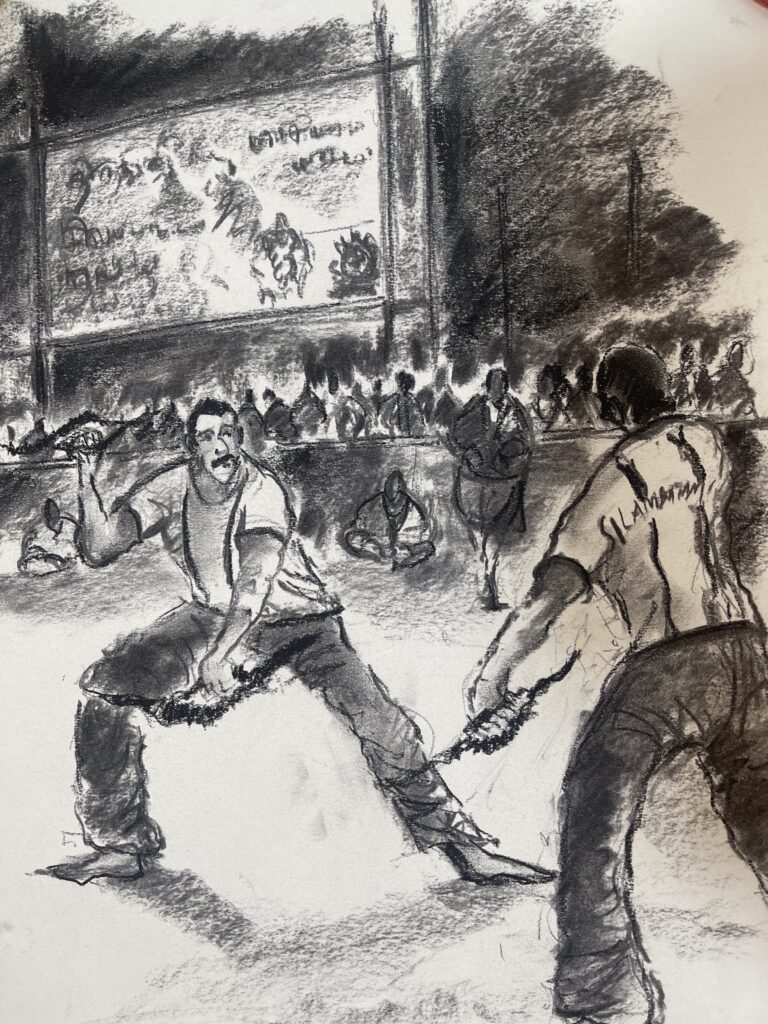
    The procession itself is an audiovisual spectacle. A cacophony of sounds, comprising of a duet or quartet of paramolams (a circular drum of about 3 feet in diameter, covered with taut cow or goat hide) , the haunting reverberations of the udukkai (a handheld small drum, in the shape of an hourglass), thunderous blowing sounds from long and semicircular country trumpets, along with pleasing tunes from traditional nadaswaram and thavil, creates an atmosphere of a massive raid. Add to it, a multitude of country dancers painted like tigers in yellow and black stripes, country martial artists swinging sticks, and weapons made from deer horns, and a group of women, dressed in red or yellow saris, with flowing hair performs sami attam, a dance in a possessed state. You watch this once, and it will leave a lasting impression for life.
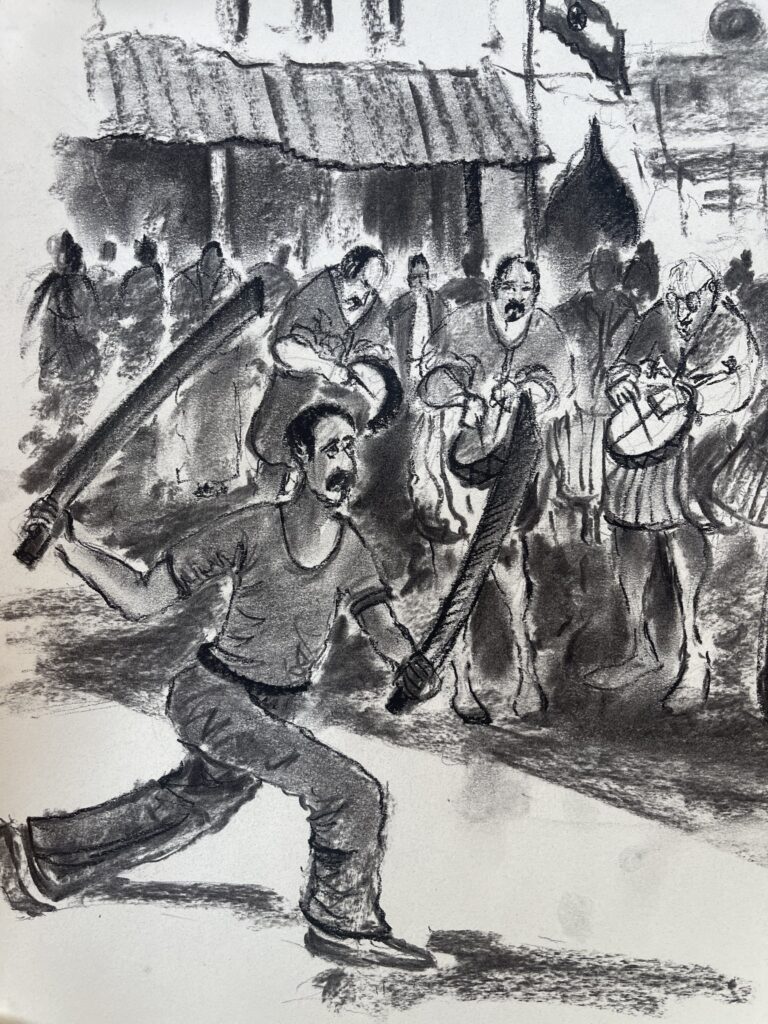
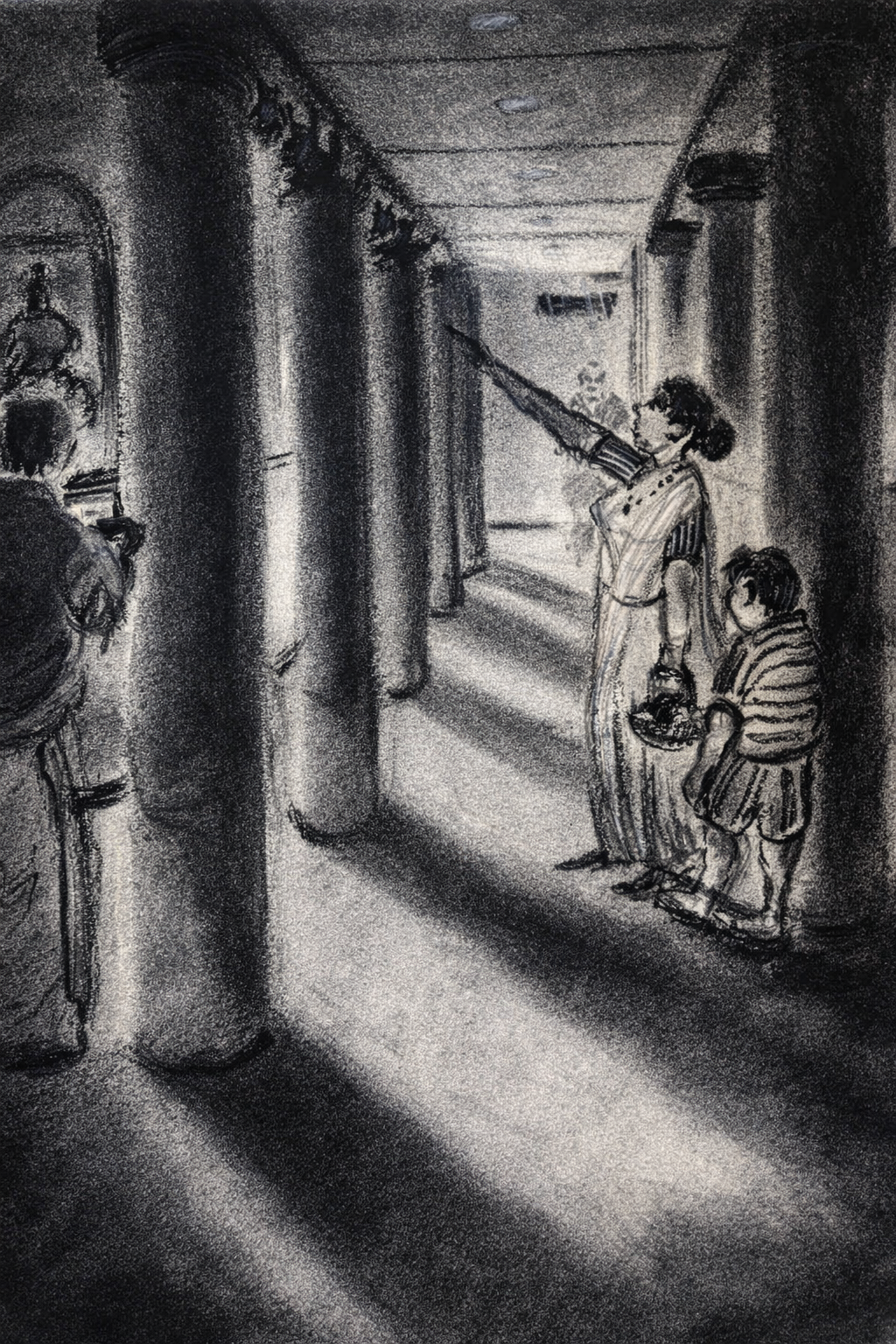
    The epitome of all the mela is the gruesome, bloody entrails of a goat carried in a thatched bamboo tray called the muram. This will not be visible at street level as the vessel is on top of the palanquin. Hence, the only way to see it is from the top. As a kid, I am always intrigued and curious to see this macabre display. However, my mom will never let us children see this bloody display. I, along with a bunch of neighborhood kids, will pretend to be at the street level, and then rush upstairs to the open terrace, jump and hang from the parapet wall, pop our heads out, as we were shorter than the parapet wall, and excitedly glance at the entrails. It usually has liver, kidneys, and intestine. Not sure if I remember if it had stomach, but definitely liver, kidneys and intestine. Sometimes a few black colored, dead, headless chickens hang from the sides of the palanquin. Story goes that during rituals conducted at the temple, the priest, in a possessed state, bites off the chicken head and spits it out!


    The entire procession goes to the Mylapore crematorium where the priest conducts a special ritual for the goddess that mimics the mythology behind this festival. I heard massive crowds throng to get Her blessings. I never ventured into the crematorium grounds until probably during college, when I went to say farewell to a very good friend.

    Pictures by my niece, an architect by profession, living in Des Moines, Iowa.
  • Dr. Appa Rao

    Dr. Appa Rao

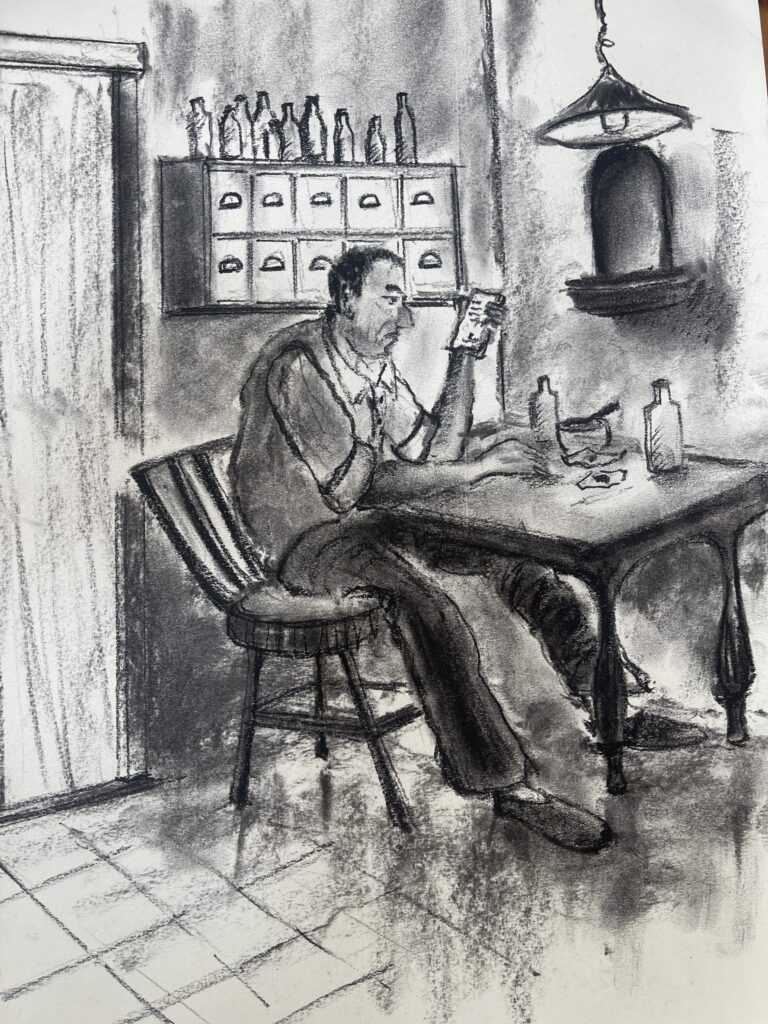
    The first doctor I remember most is the distinctive Dr. Appa Rao, who practiced in a tiny, probably 600 sqft space, that was a large room rented out by my closest friend who lived across from us (in case you are interested, his house can be seen as the backdrop in my About Me Picture). It was a lengthy room, with two tiny wooden doors, probably not more than 10 feet wide. The length of the room was divided using wooden partitions into three sections. The first section as you enter is the patient waiting area. Patients can sit on a long wooden bench, or a few steel chairs, neatly laid along the walls. A plain cloth screen adorned the entrance to the second section where the doctor examined his patients. A steel bed was also snugly fit in this section that left Dr.Appa Rao with only a few feet moving space. At the back, behind the doctor’s room is the space for the compounder.

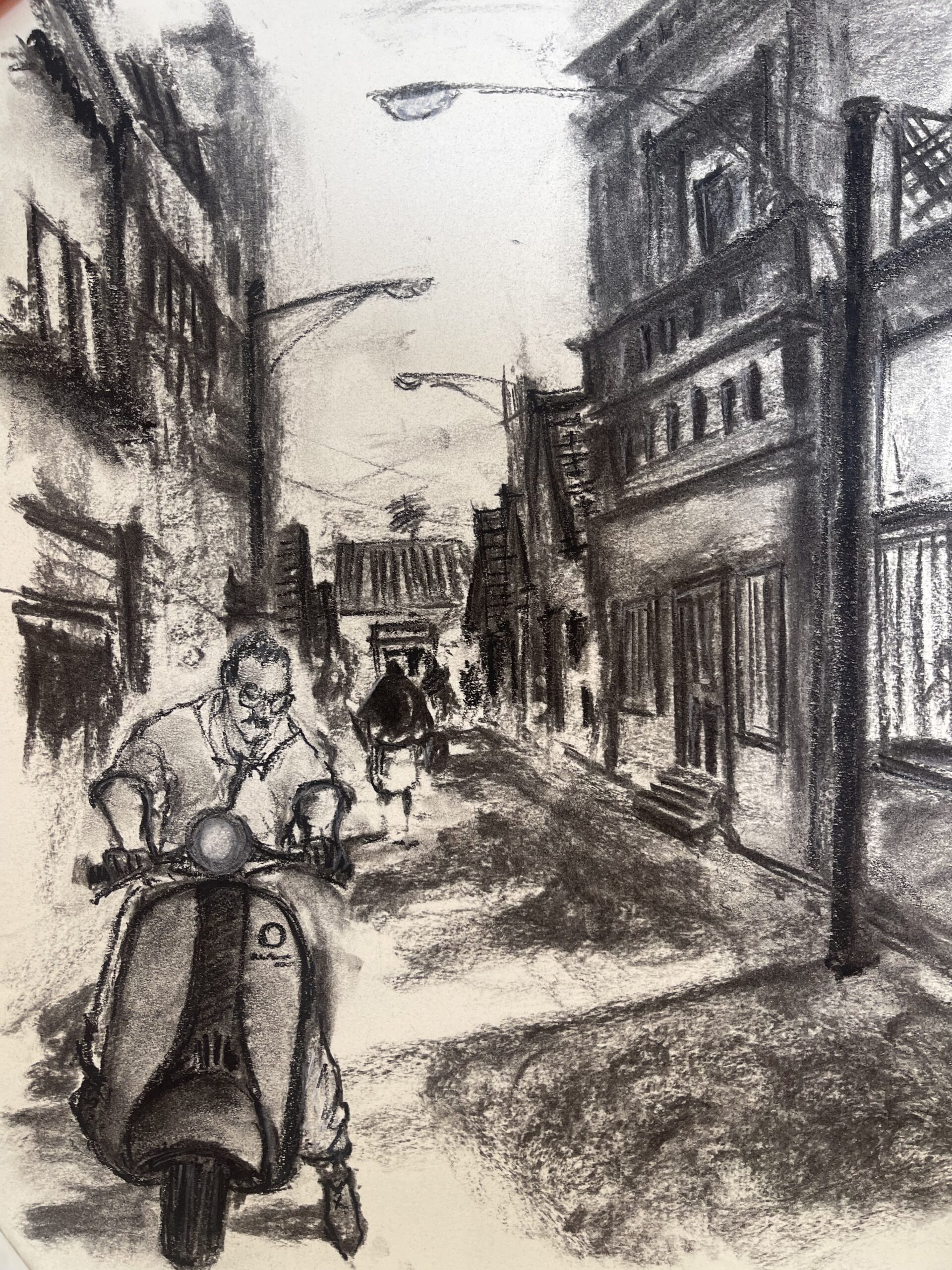
    Dr. Appa Rao is the quintessential Telugu. He was very fair and always dressed impeccably. I remember very vaguely that he usually wore a nicely pressed white shirt, and white pants, with black shoes and black rimmed eyeglasses. He drove a Lambretta scooter that he would park in in a small space in front of the his office . One thing all of us used to watch was the way he kick started his scooter. Starting would involve a sequence of operations. First, he would stand on the side of the scooter that has the kick-start pedal. Holding the handlebar in one hand, and gripping the seat back, he would release the scooter from the stand. Then, he would tilt the scooter towards him to make sure the fuel flows smoothly. Then he would twist the knob to open the fuel flow. Again, holding the handle bar with his right hand, and the seat back in his left hand, he would use his left foot to kick the pedal. As kids, we get excited to see the doctor in person, and that too, kick starting his scooter. We used to wait for this moment to observe the doctor as otherwise we get to see him only when we are sick. In particular, when he kicks with his left foot, his right foot would lift up and bend, almost mimicking a mirror image of what he is doing with his left foot. He would start his scooter in a few kicks and drive away into the night.

    Dr.Rao’s compounder was a tall lean fellow, probably in his thirties, and I never knew his name. We all called him the compounder. He used to arrive probably around 5.30 or 6.00 PM and left after the doctor leaves, around 9.00 or 9.30 PM. He drove a black classic old bicycle and, as it grew dark on the way back, he had an oil lantern affixed on the handlebar. Those days, oil lanterns served as the headlamp for bicyclists in the night. We too had one such lantern and I always enjoyed filling up oil, twisting the knob to raise the wick, open the tiny door with a tiny red colored glass window, and light it using a matchstick. Though the doctor treated us, the compounder was more near and dear to all as he dispensed the medications in right quantities. He always powdered the tablets, measured into individual doses, and packaged in small paper packets.

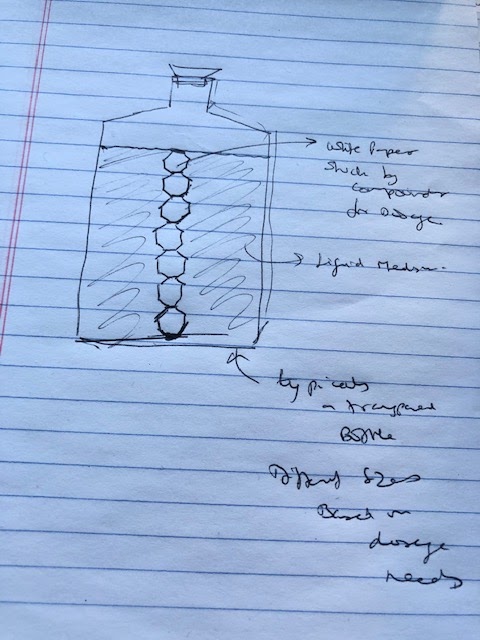
    The most interesting dispensing method is for the liquid medicines. He had a variety of transparent glass bottles in different sizes. Depending on the dosage, he would fill up the right bottle with the liquid medicine. Then he would take a long strip of paper, probably 1 cm in width and cut it to the length that matches the height of the liquid in the bottle. Then he would fold it into as many flips as the dosage, cut notches along the edge, that when straightened, looks like a series of octagons (see picture ). He would then fix this strip of paper using glue along the middle of the bottle and voila, we have our liquid medicine with correct dosage. When we are done with the dosage, we normally return the bottle back to the compounder so he can clean it and use it for another patient.

    Almost everyone in the street and nearby streets consulted with Dr. Appa Rao for common illnesses. As time passed, several of my brother’s friends became doctors and started practicing in the same neighborhood. Dr. Appa Rao grew older as well, discontinued his practice, and moved out. We never knew what happened to him or his compounder after that.

    Pictures by my niece, an architect by profession, living in Des Moines, Iowa.
  • Cats – Teaching a Lesson

    Cats – Teaching a Lesson

    There were two tomcats and probably two or three female cats that lived among the backyards of homes in our street in Mylapore, Madras. The tomcats always fought with each other at night and would make eerie sounds that often sounded like babies cooing or crying in distress. There will be a period of cooing followed by a loud commotion when one of the tomcats start chasing the other and both run over tiled rooftops at high speed, toppling some of the old terracotta tiles.

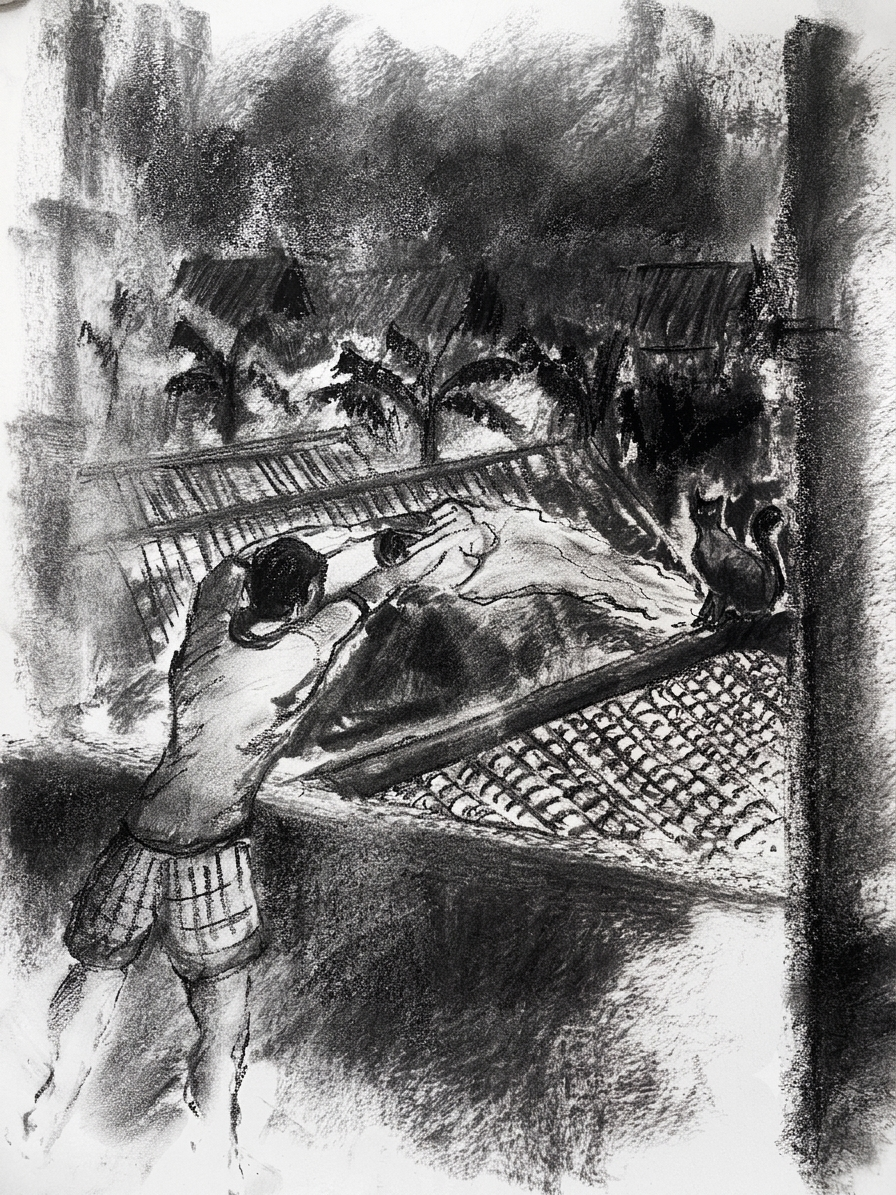
    The behavior of these cats always piqued my curiosity as a child. Sometimes I felt that the cat instinctively knows that humans cannot see in dark or they cannot run over the rooftops. I first realized this behavior when I chased a cat that strayed into the open terrace at night. As I chased it on the well-lit open terrace, it would run fast, jump over the four-foot parapet wall, land on the tiled roof, and just stay there. He would not run after that point. He would simply sit there and stare at me. The rooftop would be dark as the terrace light would not reach there and this cat would think that I cannot see in the dark, and I will not chase him any further. I have observed this same behavior a hundred times when I chase them away at night. This always annoyed me. How can a mere cat know my limitation and how dare it thinks that I will not be able to chase him once he jumps into the ghostly shadows of night. I wanted him to know that humans are better than stupid cats, that we will not give up a fight, and we too can see in dark, and we too can run over rooftops. I wanted these damn cats to know that I am way better than his kind and I can chase them all the way to the bottom of hell irrespective of darkness or light.

    I prepared for this lesson in humility well in advance. I kept a bucket of water with a pail near the parapet wall in the terrace. Cats hate water. I want to use this as a weapon to impart a valuable experience that he would never forget in his pathetic life. I waited for an opportune night that I could execute my attack plan. One night, a tomcat came inside the kitchen at night. I tiptoed past the kitchen and closed the door to our backyard. That way he cannot escape immediately into the dark backyard. Instead, he has to go through the corridor past the prayer room, living room, and climb up the stairs to the open terrace, jump over the parapet wall and only then, he would be able to vanish into the darkness of the rooftops. I started making loud noises to scare him. He started to run out of the kitchen and instinctively tried to dash through the backdoor. I laughed when I saw him bump on the door desperately trying to sneak out between the closed doors. I raised my voice and made horrendous noises to scare the hell out of him. He ran past me and started running through the house. I ran behind him like a mad man. Obviously, he outran me, but being small, I zipped fast behind him, ran up the stairs, and even climbed up the parapet wall. He then jumped down over to the rooftop and simply stared at me from the darkness thinking I cannot see him. In a few seconds, I saw him like a ghostly shadow with two shining eyes. To fool him into a false sense of security in darkness, I stared back for a while. He sat there comfortably thinking I cannot see him in the darkness. Then I quietly brought up a mug of water, and in an instant poured it over him. Poor tomcat, he got drenched completely, and ran away shaking his body, and his legs all the way until he vanished over the dark rooftops of our neighbors.

    Pictures by my niece, an architect by profession, living in Des Moines, Iowa.
  • Bats – Sinners in the Temple of Shiva

    Bats – Sinners in the Temple of Shiva

    Among nature’s creation, Bats are one of the most complex creatures that go unnoticed by busy humans. Dogs are everywhere, cats are beloved companions, and snakes are powerful demi-gods worshiped in temples. Bats on the other hand have an ill reputation of dirty creatures. No one seems to wonder at this amazing creation other than the scary caricatures of bats during Halloween or as a symbol like in the movie Batman. I loved to gaze at the amazing flight path a bat takes as it moves around. Sometimes, they appear to almost crash into a building or a tree trunk, but change direction in the blink of an eye just before you think they would crash. When they rest on a tree or a ceiling, they would be hanging upside down watching everything going on below. Our home had an open courtyard and long corridors that open on one side to the road, and other side to the backyard. Sometimes, I have seen bats flying through our home from one end to the other. It was very hard to follow them as they would fly fast and in an instant, it would be out up on the trees in the backyard.

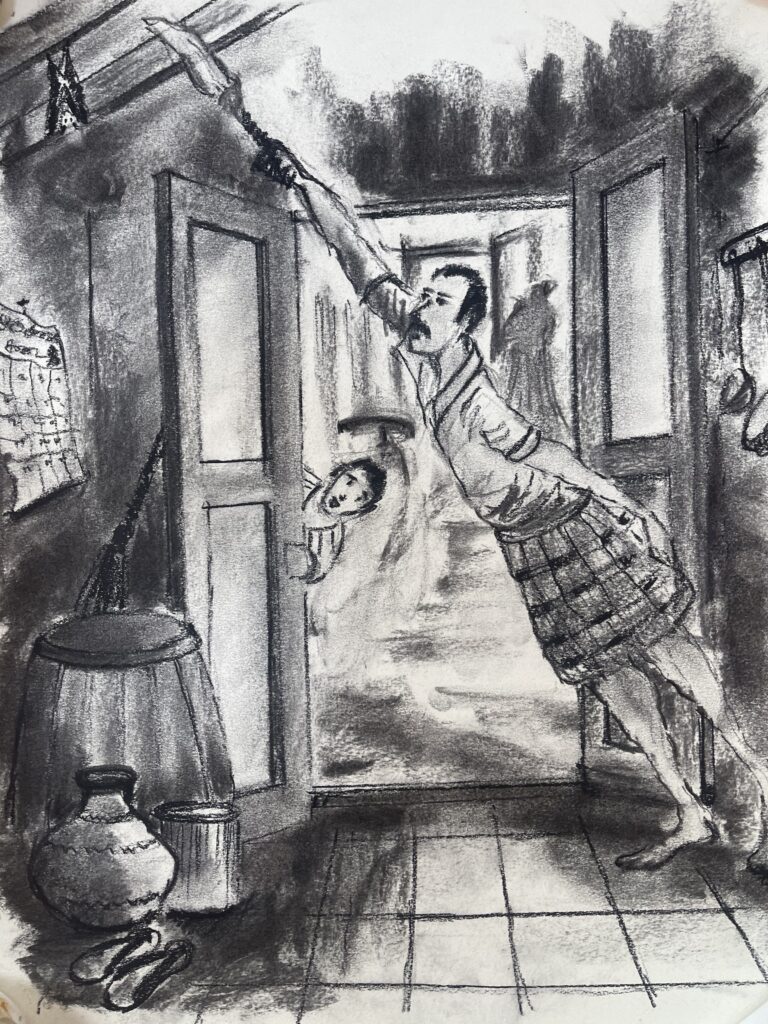
    My mother would always say that having bats come inside the house is bad omen. It is even a worse omen if the bat lived inside the house. We had many attic spaces that were dusty and had lots of junk. One time we noticed a bat living in such a cluttered old attic in a room that often acts as our dining area, very close to the back door that leads to our backyard. Apparently, it strayed from the tree, flew inside, and found this attic space a cozy home. It took us a great effort to lodge the bat out of this creepy space and chase it out. In fact, in order to make the bat not to come back, we had to scare it with a burning flame. My father’s elder brother, my uncle, took a long stick, wrapped one end with a rag cloth, dipped it in kerosene, and lighted it. Using this lighted stick, we scared and chased the bat out. According another family lore, once a bat sees fire, it will remember the location and will never come back to the same place. Finally, the bat was forever, banished from our home.

    Another time, our entire family went to visit my elder brother’s wife, my sister-in-law’s parent’s house about fifty miles north of our home. Her father used to work in a match factory, which made the famous Cheetah Fight matchboxes. In that rural neighborhood, there was a very old Shiva temple. This temple was almost near the ocean and from inside, you could hear the sound of the waves crashing on the rocky shores. In Hindu culture, Shiva is one of the trinities, the destroyer. This temple is so old that many esoteric myths lived among the folks inhabiting this village. There is a legend that the Shiva Lingam (the phallic rock representation of Shiva) grows every day. If it grows large enough such that it rises above the height of temple walls, the Lingam can then see the ocean. If the Lingam sees the ocean beyond, a great catastrophic event will happen and destroy the world. The corridors surrounding the sanctum sanctorum of the temple were damp, dark, and dimly lit. Large, square, intricately carved granite pillars towered from ground and touched the roof that was over thirty feet above. Floor was also granite, and along the outside walls, stood stone sculptures of the disciples of Shiva and various gods, demi-gods and goddesses. Inside the dark and dimly lit corridors of the temple, thousands of bats lived and hung upside down from the dark roofs above. Sometimes they made such blood curdling noise and will sweep down from the ceiling, go from one end of the corridor to another and swing back up to hang upside down again. My mother always reminded that anyone who commits a sin, and that too a sin that would disrespect Lord Shiva or any of his disciples or devotes, would be born again as a bat in their next life and hang upside down in a Shiva temple. As I left, I felt bad for those thousands of sinners who have to spend their life inside the Shiva temple. I hope they would accumulate enough good deeds from being in the presence of Shiva the destroyer and be born again as humans in their soul’s next journey.

    Pictures by my niece, an architect by profession, living in Des Moines, Iowa.
  • Cowboy Raja

    Cowboy Raja

    In the temple city of Mylapore, Madras, our home had a verandah in the front right as you enter the house through the small, twin, green wooden doors. This verandah served a multitude of purposes. It was closed on three sides: the back, and the left and right sides. The front had a big 6×10 opening that had a geometrically shaped grill, made of metal bars, probably 10mm square steel rods. You can easily sit in the verandah on a chair and watch everything and everyone go by in the street. Often my uncle or elder brother would carry bicycles into the house and park it in the verandah. On the south wall inside the veranda, we had the electric main with fuse and main switch. The grill in the front opening served as a tie-post for the cows that belonged to our friendly neighborhood milkman named Raja.

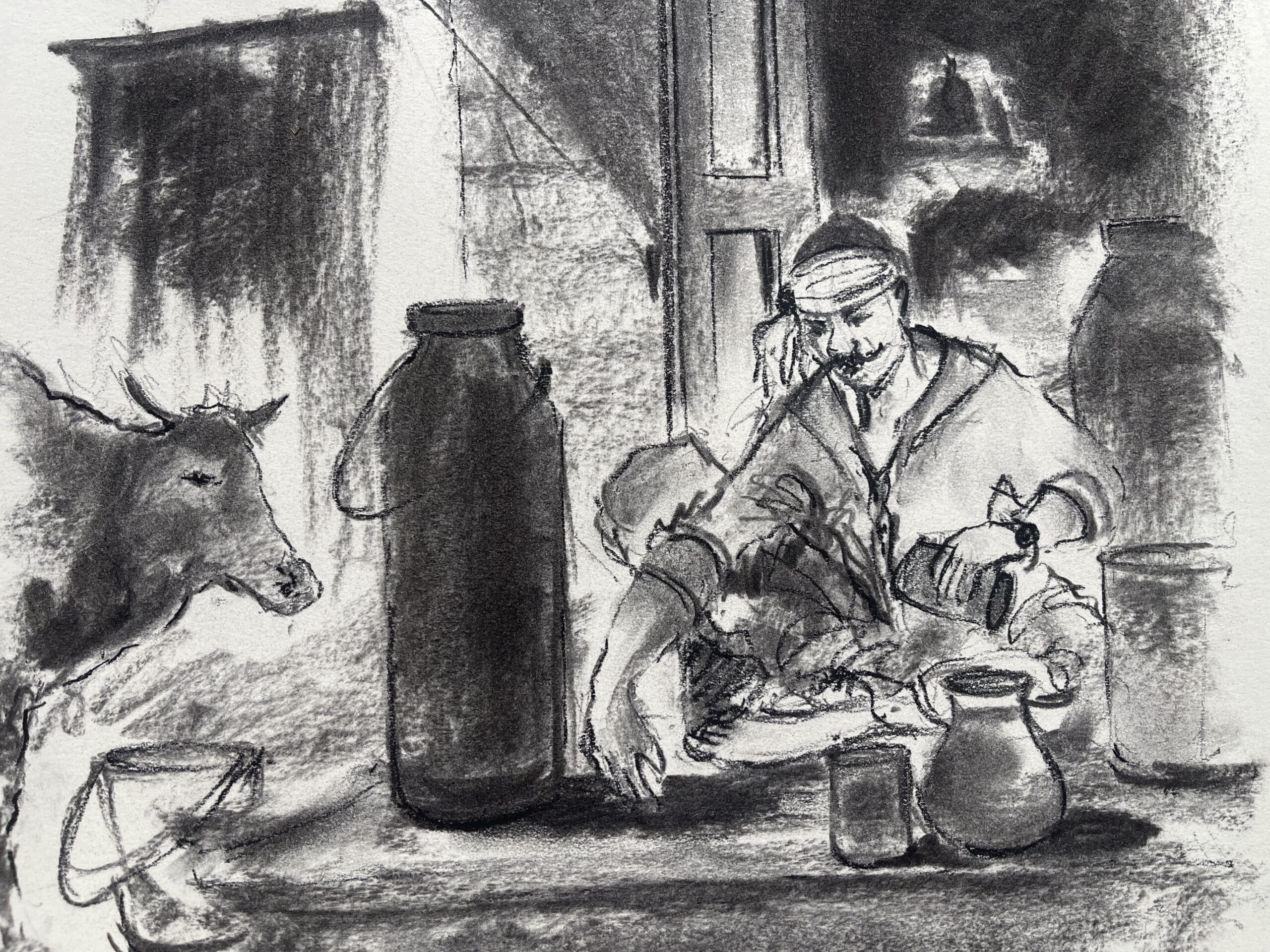
    Before the widespread adoption of pasteurized milk in bottles and plastic containers, everyone in our neighborhood always bought fresh milk, milked from the cows, that was then sold by Raja, from large stainless steel containers in a small shop next to our home. The shop is nothing more than a five foot by five foot opening, which was about another five feet deep, with no lights or electricity or any kind of convenience. If my memory was correct, there was a small awning on the top, and it had small green wooden double doors. This was the castle of Raja. Raja was quite a character. He always wore a white dhothi (a large piece of cloth tied around the waist, a traditional south Indian dress for males) and white full hand shirt, with sleeves folded. Most of the time, he wore a white turban, thick black glasses and sported a big black mustache. He owned several cows and had a few assistants to herd, feed, and milk them. Back in the day, and probably even today, having cows and making a livelihood from selling milk, is considered unattractive since a city dweller does not want to herd cows, take care of them, clean their droppings and milk them. However, the image of a western cowboy conjured a cool and awesome image. Hence, my niece and I, as we always like to coin nicknames for colorful characters, christened our milkman as Cowboy Raja.

    Every day, without fail, my mom would collect all the vegetable scraps from the day’s cooking and combine them with the starch left over from boiling rice in a tin container. Cowboy Raja’s assistant would provide such tin containers to a few families in the neighborhood who volunteer to donate the scraps, and collect them when the cows arrive. Cowboy Raja sometimes would walk with the cows, or come in a bicycle while his assistants would bring them, without fail, around two PM. Typically, there would be three or four cows and the assistant would tie a few of them to the grill in our verandah. We often would stand inside the verandah, sneak our hands out through the gaps in the grill, and touch the cows. The assistant would mix some feed along with the contents from the collected tin containers, make a feed, and distribute to the cows in wooden vessels. The cows would happily eat them, and the milking would start.

    When the first squirts are pulled from the udder into the cylindrical tin milk containers, it would make a nice chirpy rhythmic, “tringg..tringg” metallic noise that would quickly fade into a dull “burrr..burrr” as the milk starts filling up in the container. The most distinctive thing I remember is the fake straw calves. Cows form milk once the calves are born. Cowboy Raja would raise the calves to sell them later but often the calves die due to complications. If the calves are alive, they would accompany their mommy cows and get a few sucks from the udder first when milking starts. They would then be whisked to the other side while the assistant milks rest of the milk from the mommy cow. The saddest part is when the calves die. To keep the mommy cow thinking that her calf is alive, they would make a calf lookalike, albeit a very crude one, out of straw and sticks. These straw calves would come with the cow caravan and kept next to the mommy cow so that she continues to secret milk. It is sad to see when mommy cow fondly tries to lick the straw calf thinking it is alive and drinking her milk.

    Once milked, the milk would then be transferred from the cylindrical containers to a steel buckets in Cowboy Raja’s shop. My mom would give me a stainless steel vessel, with some cash, and I would walk past the cows to Raja’s shop. There I would ask for a quarter liter of milk. Raja had aluminum-measuring cups of various denominations. I always wondered at the big one-liter containers and thought who would need such a large quantity of milk. Raja would dip into the bucket, measure the milk, and pour it into my stainless steel vessel. For posterity’s sake, he would measure a few additional milliliters in a small measuring cup and add it to our vessel. You would leave a happy kid, as you got a bit more than quarter liter. I wonder what happened to Cowboy Raja, his cows and his family as everyone buys milk from supermarkets now.

    Picture by my niece, an architect by profession, living in Des Moines, Iowa.